> ## Documentation Index
> Fetch the complete documentation index at: https://docs.anyformat.ai/llms.txt
> Use this file to discover all available pages before exploring further.
# Validate
> Checks the values an Extract node produced against your rules and records a verdict per rule. Deterministic checks are free; AI rules cost 5 credits each.
**Validate** runs a list of rules over the fields an [Extract](/guides/nodes/extract) node produced and records a verdict for each rule: **pass**, **fail**, or **inconclusive**. It lives in the **Logic** section of the Studio palette.
Every rule is one of two kinds, and one Validate node can mix both:
| Rule kind | How it is checked | Best for | Cost |
| ----------------- | ------------------------------------------------------------------ | ---------------------------------------------------------------------------------------------------------------------------------- | ------------------ |
| **Deterministic** | A structured check runs in code. No model. | Exact, testable conditions: a number in range, `a + b = c`, a value in a set, a pattern, a required field, a confidence threshold. | Free |
| **AI** | A model reads your plain-language description and judges the data. | Fuzzy or semantic conditions: "the vendor looks like a real company", "the two names refer to the same person". | 5 credits per rule |
Use a **deterministic** rule whenever a calculator or a lookup could settle the condition. It is instant, free, and never flakes. Use an **AI** rule when the condition needs judgement or language understanding.
## The node
```json API theme={null}
{
"id": "validate_1",
"type": "validate",
"rules": [
{
"id": "totals-add-up",
"kind": "deterministic",
"severity": "error",
"check": { "type": "arithmetic", "operands": ["subtotal", "tax"], "operator": "sum", "equals": "total", "tolerance": 0.01 }
},
{
"id": "vendor-legit",
"kind": "ai",
"severity": "warning",
"description": "The vendor is a real, named company."
}
]
}
```
```python Python theme={null}
import os
from anyformat.sdk import Client
from anyformat.workflow import Schema, ValidationRule, ArithmeticCheck
client = Client(api_key=os.environ["ANYFORMAT_API_KEY"])
workflow = (
client.workflow("Invoice with checks")
.parse()
.extract([
Schema.float("subtotal", "Subtotal before tax."),
Schema.float("tax", "Tax amount."),
Schema.float("total", "Grand total."),
Schema.string("vendor_name", "Vendor name."),
])
.validate(
ValidationRule(id="totals-add-up", kind="deterministic", severity="error",
check=ArithmeticCheck(type="arithmetic", operands=["subtotal", "tax"], equals="total", tolerance=0.01)),
ValidationRule(id="vendor-legit", description="The vendor is a real, named company."),
)
.create()
)
```
```typescript TypeScript theme={null}
import { Anyformat, Schema } from "@anyformat/sdk";
const af = new Anyformat({ apiKey: process.env.ANYFORMAT_API_KEY! });
const workflow = await af
.workflow("Invoice with checks")
.parse()
.extract([
Schema.float("subtotal", "Subtotal before tax."),
Schema.float("tax", "Tax amount."),
Schema.float("total", "Grand total."),
Schema.string("vendor_name", "Vendor name."),
])
.validate([
{ id: "totals-add-up", kind: "deterministic", severity: "error",
check: { type: "arithmetic", operands: ["subtotal", "tax"], operator: "sum", equals: "total", tolerance: 0.01 } },
{ id: "vendor-legit", kind: "ai", description: "The vendor is a real, named company." },
])
.create();
```
`validate()` attaches the node to the last `extract()` you called. Pass `branch=` (Python) or `{ branch }` (TypeScript) to attach it to the Extract on one Classify category or Split rule instead.
A check names a field by the **name** you gave it on the Extract node. Studio names fields by their persistent id instead; both forms resolve at run time. An **expression** check is the exception: it reads names only.
## In Studio
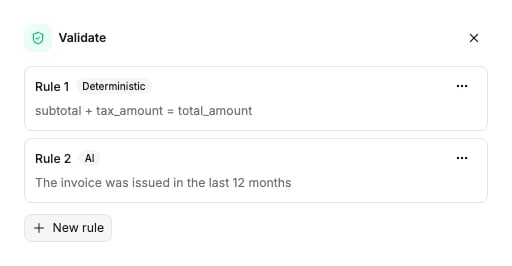
Click the Validate node on the canvas to open its panel. Each rule is a card. Pick **AI validation** or **Deterministic validation** at the top of the card: an AI rule takes a sentence, a deterministic rule takes a subject (a field value, field math, or an expression) and the assertion that completes "Check that the field…". Set the severity and click **Save rule**.
 ## Options
| Field | Type | Default | What it does |
| ------- | ------------- | ---------------------- | ---------------------------------------------------------------------------------------------- |
| `rules` | list of rules | required, at least one | The rules to evaluate. Every rule runs on every extraction; a failed rule never stops the run. |
Each rule:
| Field | Type | Default | What it does |
| --------------- | ----------------------- | -------- | --------------------------------------------------------------------------------------------------------------------------------------------------------------------------- |
| `id` | string | required | Stable rule id. It names the rule in results, in an [If/Else](/guides/nodes/if-else) `validation` condition, and in a [Slack alert](/guides/nodes/slack-alert) placeholder. |
| `name` | string | `null` | Human-readable name shown in the app. |
| `kind` | `ai` \| `deterministic` | `ai` | How the rule is checked. |
| `description` | string | `null` | The plain-language rule a model judges. Required when `kind` is `ai`; must be absent otherwise. |
| `check` | check object | `null` | The structured check (table below). Required when `kind` is `deterministic`; must be absent otherwise. |
| `severity` | `error` \| `warning` | `error` | How a failed rule is labelled in results. Display only: it never blocks the run. |
| `source_fields` | list of strings | `[]` | Persistent ids of the fields the rule reads. Studio fills it in; the API does not need it. |
The schema the API accepts is generated from the same source: [Validate node schema](/api-reference-v3/node-schemas#validate).
### Checks
Every check kind below is deterministic and free. Two are combinators that nest other checks.
| Check | `type` | What it asserts | Example |
| ------------------- | ------------ | ---------------------------------------------------------------------------------------------------- | ----------------------------------------------- |
| **Required** | `required` | The field is present and not empty. | `vendor_name` is filled in |
| **Number in range** | `range` | A numeric field falls within `min` and `max` (inclusive; either may be `null`). | `amount` between `0` and `1000000` |
| **Date in range** | `date` | A date field falls within `earliest` and `latest`: each an ISO date, the literal `today`, or `null`. | `expiry_date` on or after `today` (not expired) |
| **Arithmetic** | `arithmetic` | A `sum`, `subtract`, or `product` of fields equals another field, within `tolerance`. | `subtotal + tax = total` (±0.01) |
| **Comparison** | `comparison` | A field compares (`==`, `!=`, `>`, `>=`, `<`, `<=`) to a fixed value or another field. | `end_date >= start_date` |
| **One of** | `one_of` | The field's value is in an allowed set. `case_sensitive` defaults to `false`. | `currency` is one of `EUR`, `USD`, `GBP` |
| **Pattern** | `regex` | The field matches a regular expression (RE2 syntax, linear time). | `iban` matches `^[A-Z]{2}\d{2}` |
| **Confidence** | `confidence` | The field's extraction confidence (0 to 100) compares to `threshold`. | `total` has confidence `>= 80` |
| **Expression** | `expression` | A [CEL](https://cel.dev/) expression over the whole extraction answers true or false. | the line items add up to the total |
| **All of** | `all_of` | Every nested check passes. | required **and** in range |
| **Any of** | `any_of` | At least one nested check passes. | matches pattern A **or** pattern B |
Each check resolves to **pass**, **fail**, or **inconclusive**. A check is inconclusive when the field it names is missing, or cannot be read as the expected type. Numbers are read leniently: `"€1.234,56"` and `"1,234.56"` both parse. Dates accept the common written formats.
`all_of` fails if any child fails, otherwise it is inconclusive if any child is inconclusive, otherwise it passes. `any_of` passes if any child passes, otherwise it is inconclusive if any child is inconclusive, otherwise it fails. A combinator holds up to 32 checks. Studio nests one level; the API accepts deeper nesting.
A rule's check cannot contain a `validation` check (the outcome of another rule). The API rejects it. To act on a rule's verdict, route on it with an [If/Else](/guides/nodes/if-else) node instead.
### Check payloads
```jsonc theme={null}
{ "type": "required", "field": "vendor_name" }
{ "type": "range", "field": "amount", "min": 0, "max": null }
// Date bounds: an ISO date "YYYY-MM-DD", "today" (relative), or null.
{ "type": "date", "field": "expiry_date", "earliest": "today", "latest": null } // not expired
{ "type": "date", "field": "invoice_date", "earliest": "2024-01-01", "latest": "2024-12-31" }
{ "type": "arithmetic", "operands": ["subtotal", "tax"], "operator": "sum", "equals": "total", "tolerance": 0.01 }
{ "type": "comparison", "left": "end_date", "op": ">=", "right": { "source": "field", "field": "start_date" } }
{ "type": "comparison", "left": "year", "op": ">=", "right": { "source": "literal", "value": 2000 } }
{ "type": "one_of", "field": "currency", "allowed": ["EUR", "USD", "GBP"], "case_sensitive": false }
{ "type": "regex", "field": "iban", "pattern": "^[A-Z]{2}\\d{2}" }
{ "type": "confidence", "field": "total", "op": ">=", "threshold": 80 }
{ "type": "expression", "expression": "sum(data.lines.map(l, num(l.amount))) == num(data.total)" }
{ "type": "all_of", "checks": [
{ "type": "required", "field": "iban" },
{ "type": "regex", "field": "iban", "pattern": "^[A-Z]{2}\\d{2}" }
] }
{ "type": "any_of", "checks": [
{ "type": "one_of", "field": "currency", "allowed": ["EUR"] },
{ "type": "range", "field": "total", "min": null, "max": 10000 }
] }
```
`operator` defaults to `sum`; `tolerance` to `0`; `case_sensitive` to `false`. Unset bounds are `null`. `threshold` is an integer from 0 to 100.
### Expressions
An **expression** check runs a [CEL](https://cel.dev/) expression over the whole extraction. Use it for a condition the other checks cannot name: a total over a list of line items, a per-row comparison, a conditional.
```
abs(sum(data.lineas.map(l, l.importe)) - num(data.ibruto)) <= 1.0
```
That is the rule this check was built for: the line items of an invoice must add up to the gross amount, within a tolerance of 1.0. The names are the ones the schema defines, in whatever language it uses.
* The expression reads one root variable, `data`, which holds the whole extraction.
* Fields use their **extracted name**: `data.ibruto`, `data.lineas`. An expression names no persistent id, so **renaming a field in the schema breaks every expression that names it**. The rule then reports **inconclusive**.
* The [CEL builtins](https://github.com/google/cel-spec/blob/master/doc/langdef.md) all work: `map`, `filter`, `all`, `exists`, `size`, `has`, `startsWith`.
* Three helpers come on top of them, because CEL coerces no number and folds no list, and an extracted value is frequently a string such as `"1.234,56"`:
* `num(v)` reads one value as a number, with the same lenient parse the other checks use.
* `sum(list)` adds a list, and reads each element the same way. Bare `+` does not: on two strings it joins them end to end.
* `abs(x)`.
* `has(data.x)` asks whether the key is there, not whether it holds a value. A field that was extracted as null answers `true`. A rule that means "was extracted" reads `data.x != null`.
* Every evaluation error resolves to **inconclusive**: an expression that does not parse, that names a field the extraction does not carry, that divides by zero, or that answers with something other than a boolean. An expression never fails the run.
## What it returns
One verdict per rule per extraction. The run results carry them as `extractions[].validations[]`, on the entry whose fields the rules judged, so in a split workflow each piece carries its own. The key is always present: `[]` when the workflow has no Validate node.
| Field | Meaning |
| ----------------- | --------------------------------------------------------------------------------------- |
| `rule_id` | The rule's `id`. |
| `description` | The rule's description, as shown in the app. Empty for a deterministic rule. |
| `severity` | `error` or `warning`, copied from the rule. |
| `status` | `pass`, `fail`, or `inconclusive`. |
| `detail` | A sentence that says why: the values compared, or the model's reasoning for an AI rule. |
| `compared_values` | The values the check read. |
| `source_fields` | The `persistent_id`s of the fields the rule read. |
In the app, the verdicts appear in the **Validation** tab of the results, next to the extracted data. See [Verification and review](/guides/workflows/verification-review). A failed rule marks the document; it never stops the run or hides the extraction.
Downstream nodes read the verdicts too. An [If/Else](/guides/nodes/if-else) node routes on a rule's outcome with a `validation` condition, and a [Slack alert](/guides/nodes/slack-alert) prints it with `${validation..status}`.
On the public API the verdicts sit in each `extractions[]` entry of [`GET /v3/runs/{run_id}/`](/api-reference-v3/runs/get). The Python SDK exposes them as `result.validations` (per partition, `result.partitions[i].validations`); the TypeScript SDK as `extraction.validations` on each entry of `result.extractions`.
## Connects to
| Direction | Nodes |
| --------- | ---------------------------------------------------------------------------------------------------------------- |
| Fed by | [Extract](/guides/nodes/extract). One Validate reads exactly one Extract. |
| Feeds | [If/Else](/guides/nodes/if-else), [Slack alert](/guides/nodes/slack-alert), [Knowledge](/guides/nodes/knowledge) |
Validate passes the extraction through unchanged, so a node after it sees the same fields the Extract produced.
## Billing
An **AI** rule costs **5 credits**, billed once per rule per extraction, not per page. A **deterministic** rule, including an expression, costs **0 credits**. A three-rule Validate with one AI rule costs 5 credits whether the document is 1 page or 100. Full price list: [How credits work](/concepts/how-credits-work).
## Examples
* [Invoice processing](/examples/invoice-processing): the Extract the rules on this page check. Add the `totals-add-up` and `vendor-legit` rules after it.
* [Bank statement processing](/examples/bank-statement-processing): an `expression` check that sums the transactions against the closing balance.
## Options
| Field | Type | Default | What it does |
| ------- | ------------- | ---------------------- | ---------------------------------------------------------------------------------------------- |
| `rules` | list of rules | required, at least one | The rules to evaluate. Every rule runs on every extraction; a failed rule never stops the run. |
Each rule:
| Field | Type | Default | What it does |
| --------------- | ----------------------- | -------- | --------------------------------------------------------------------------------------------------------------------------------------------------------------------------- |
| `id` | string | required | Stable rule id. It names the rule in results, in an [If/Else](/guides/nodes/if-else) `validation` condition, and in a [Slack alert](/guides/nodes/slack-alert) placeholder. |
| `name` | string | `null` | Human-readable name shown in the app. |
| `kind` | `ai` \| `deterministic` | `ai` | How the rule is checked. |
| `description` | string | `null` | The plain-language rule a model judges. Required when `kind` is `ai`; must be absent otherwise. |
| `check` | check object | `null` | The structured check (table below). Required when `kind` is `deterministic`; must be absent otherwise. |
| `severity` | `error` \| `warning` | `error` | How a failed rule is labelled in results. Display only: it never blocks the run. |
| `source_fields` | list of strings | `[]` | Persistent ids of the fields the rule reads. Studio fills it in; the API does not need it. |
The schema the API accepts is generated from the same source: [Validate node schema](/api-reference-v3/node-schemas#validate).
### Checks
Every check kind below is deterministic and free. Two are combinators that nest other checks.
| Check | `type` | What it asserts | Example |
| ------------------- | ------------ | ---------------------------------------------------------------------------------------------------- | ----------------------------------------------- |
| **Required** | `required` | The field is present and not empty. | `vendor_name` is filled in |
| **Number in range** | `range` | A numeric field falls within `min` and `max` (inclusive; either may be `null`). | `amount` between `0` and `1000000` |
| **Date in range** | `date` | A date field falls within `earliest` and `latest`: each an ISO date, the literal `today`, or `null`. | `expiry_date` on or after `today` (not expired) |
| **Arithmetic** | `arithmetic` | A `sum`, `subtract`, or `product` of fields equals another field, within `tolerance`. | `subtotal + tax = total` (±0.01) |
| **Comparison** | `comparison` | A field compares (`==`, `!=`, `>`, `>=`, `<`, `<=`) to a fixed value or another field. | `end_date >= start_date` |
| **One of** | `one_of` | The field's value is in an allowed set. `case_sensitive` defaults to `false`. | `currency` is one of `EUR`, `USD`, `GBP` |
| **Pattern** | `regex` | The field matches a regular expression (RE2 syntax, linear time). | `iban` matches `^[A-Z]{2}\d{2}` |
| **Confidence** | `confidence` | The field's extraction confidence (0 to 100) compares to `threshold`. | `total` has confidence `>= 80` |
| **Expression** | `expression` | A [CEL](https://cel.dev/) expression over the whole extraction answers true or false. | the line items add up to the total |
| **All of** | `all_of` | Every nested check passes. | required **and** in range |
| **Any of** | `any_of` | At least one nested check passes. | matches pattern A **or** pattern B |
Each check resolves to **pass**, **fail**, or **inconclusive**. A check is inconclusive when the field it names is missing, or cannot be read as the expected type. Numbers are read leniently: `"€1.234,56"` and `"1,234.56"` both parse. Dates accept the common written formats.
`all_of` fails if any child fails, otherwise it is inconclusive if any child is inconclusive, otherwise it passes. `any_of` passes if any child passes, otherwise it is inconclusive if any child is inconclusive, otherwise it fails. A combinator holds up to 32 checks. Studio nests one level; the API accepts deeper nesting.
A rule's check cannot contain a `validation` check (the outcome of another rule). The API rejects it. To act on a rule's verdict, route on it with an [If/Else](/guides/nodes/if-else) node instead.
### Check payloads
```jsonc theme={null}
{ "type": "required", "field": "vendor_name" }
{ "type": "range", "field": "amount", "min": 0, "max": null }
// Date bounds: an ISO date "YYYY-MM-DD", "today" (relative), or null.
{ "type": "date", "field": "expiry_date", "earliest": "today", "latest": null } // not expired
{ "type": "date", "field": "invoice_date", "earliest": "2024-01-01", "latest": "2024-12-31" }
{ "type": "arithmetic", "operands": ["subtotal", "tax"], "operator": "sum", "equals": "total", "tolerance": 0.01 }
{ "type": "comparison", "left": "end_date", "op": ">=", "right": { "source": "field", "field": "start_date" } }
{ "type": "comparison", "left": "year", "op": ">=", "right": { "source": "literal", "value": 2000 } }
{ "type": "one_of", "field": "currency", "allowed": ["EUR", "USD", "GBP"], "case_sensitive": false }
{ "type": "regex", "field": "iban", "pattern": "^[A-Z]{2}\\d{2}" }
{ "type": "confidence", "field": "total", "op": ">=", "threshold": 80 }
{ "type": "expression", "expression": "sum(data.lines.map(l, num(l.amount))) == num(data.total)" }
{ "type": "all_of", "checks": [
{ "type": "required", "field": "iban" },
{ "type": "regex", "field": "iban", "pattern": "^[A-Z]{2}\\d{2}" }
] }
{ "type": "any_of", "checks": [
{ "type": "one_of", "field": "currency", "allowed": ["EUR"] },
{ "type": "range", "field": "total", "min": null, "max": 10000 }
] }
```
`operator` defaults to `sum`; `tolerance` to `0`; `case_sensitive` to `false`. Unset bounds are `null`. `threshold` is an integer from 0 to 100.
### Expressions
An **expression** check runs a [CEL](https://cel.dev/) expression over the whole extraction. Use it for a condition the other checks cannot name: a total over a list of line items, a per-row comparison, a conditional.
```
abs(sum(data.lineas.map(l, l.importe)) - num(data.ibruto)) <= 1.0
```
That is the rule this check was built for: the line items of an invoice must add up to the gross amount, within a tolerance of 1.0. The names are the ones the schema defines, in whatever language it uses.
* The expression reads one root variable, `data`, which holds the whole extraction.
* Fields use their **extracted name**: `data.ibruto`, `data.lineas`. An expression names no persistent id, so **renaming a field in the schema breaks every expression that names it**. The rule then reports **inconclusive**.
* The [CEL builtins](https://github.com/google/cel-spec/blob/master/doc/langdef.md) all work: `map`, `filter`, `all`, `exists`, `size`, `has`, `startsWith`.
* Three helpers come on top of them, because CEL coerces no number and folds no list, and an extracted value is frequently a string such as `"1.234,56"`:
* `num(v)` reads one value as a number, with the same lenient parse the other checks use.
* `sum(list)` adds a list, and reads each element the same way. Bare `+` does not: on two strings it joins them end to end.
* `abs(x)`.
* `has(data.x)` asks whether the key is there, not whether it holds a value. A field that was extracted as null answers `true`. A rule that means "was extracted" reads `data.x != null`.
* Every evaluation error resolves to **inconclusive**: an expression that does not parse, that names a field the extraction does not carry, that divides by zero, or that answers with something other than a boolean. An expression never fails the run.
## What it returns
One verdict per rule per extraction. The run results carry them as `extractions[].validations[]`, on the entry whose fields the rules judged, so in a split workflow each piece carries its own. The key is always present: `[]` when the workflow has no Validate node.
| Field | Meaning |
| ----------------- | --------------------------------------------------------------------------------------- |
| `rule_id` | The rule's `id`. |
| `description` | The rule's description, as shown in the app. Empty for a deterministic rule. |
| `severity` | `error` or `warning`, copied from the rule. |
| `status` | `pass`, `fail`, or `inconclusive`. |
| `detail` | A sentence that says why: the values compared, or the model's reasoning for an AI rule. |
| `compared_values` | The values the check read. |
| `source_fields` | The `persistent_id`s of the fields the rule read. |
In the app, the verdicts appear in the **Validation** tab of the results, next to the extracted data. See [Verification and review](/guides/workflows/verification-review). A failed rule marks the document; it never stops the run or hides the extraction.
Downstream nodes read the verdicts too. An [If/Else](/guides/nodes/if-else) node routes on a rule's outcome with a `validation` condition, and a [Slack alert](/guides/nodes/slack-alert) prints it with `${validation..status}`.
On the public API the verdicts sit in each `extractions[]` entry of [`GET /v3/runs/{run_id}/`](/api-reference-v3/runs/get). The Python SDK exposes them as `result.validations` (per partition, `result.partitions[i].validations`); the TypeScript SDK as `extraction.validations` on each entry of `result.extractions`.
## Connects to
| Direction | Nodes |
| --------- | ---------------------------------------------------------------------------------------------------------------- |
| Fed by | [Extract](/guides/nodes/extract). One Validate reads exactly one Extract. |
| Feeds | [If/Else](/guides/nodes/if-else), [Slack alert](/guides/nodes/slack-alert), [Knowledge](/guides/nodes/knowledge) |
Validate passes the extraction through unchanged, so a node after it sees the same fields the Extract produced.
## Billing
An **AI** rule costs **5 credits**, billed once per rule per extraction, not per page. A **deterministic** rule, including an expression, costs **0 credits**. A three-rule Validate with one AI rule costs 5 credits whether the document is 1 page or 100. Full price list: [How credits work](/concepts/how-credits-work).
## Examples
* [Invoice processing](/examples/invoice-processing): the Extract the rules on this page check. Add the `totals-add-up` and `vendor-legit` rules after it.
* [Bank statement processing](/examples/bank-statement-processing): an `expression` check that sums the transactions against the closing balance.